You are about to dig. Maybe it is a queen palm going in near the corner of the driveway, or fence posts along the property line, or a pool that finally got permitted, or a stretch of driveway coming out and going back in. Maybe there is no project at all, just a soft patch of grass that will not dry out and a water bill that jumped for no reason you can explain. Either way you end up standing in the yard asking a question that feels like it should have an easy answer: where exactly does my water line run?
The honest answer is that you almost certainly cannot tell by looking, and the assumption nearly everyone makes, that the line runs straight from the meter to the house, is wrong often enough that it is a bad thing to dig on. This guide covers what you can work out yourself for free, the one phone call Florida law requires you to make first, and the gap in that free service that catches homeowners out again and again. It also covers the point where guessing stops being worth it.
Call 811 First. It Is Free, and in Florida It Is the Law
Before anything else, call 811. In Florida that reaches Sunshine State One Call, the statewide notification center. You tell them where you plan to dig, and they notify the utility companies with public facilities in that area. Those companies send locators out to mark their lines on the ground in paint and flags, color coded by utility type. It costs you nothing. It is also not a formality or a contractor-only rule: Florida law requires notice before excavation, and a homeowner with a post hole digger is excavating the same as anyone else. You can place the ticket by phone or online.
Call at least two full business days before you dig. The day you call does not count, and weekends and holidays do not count either, so a Friday call does not clear you for Monday morning. Marks do not last forever, either. Paint fades, flags get mowed down or pulled out by kids, and the ticket itself expires, so do not call months ahead of a job that keeps slipping. If the marks are gone or the dig has slid past the window, call again. Once you do have marks, hand dig within roughly two feet either side of them instead of putting a machine through.
811 Marks Up to the Meter. It Does Not Mark Your Yard.
This is the most important thing here, and the part almost nobody knows until it goes wrong. What 811 gets you is the public utility's own infrastructure: the main in the street, the lines in the easement and the right of way, up to the point where the service stops being theirs and starts being yours. For water, that handoff point is the meter. The locator marks the main and the company's service up to the meter box, and then stops. Everything past the meter is private property, and no one is being dispatched to mark it for you.
Look at what that leaves unmarked. The water service line from the meter to the house. Irrigation mains and zone lines. The electrical run out to a shed, pool equipment pad, dock, or landscape lighting. Gas to a grill or pool heater. A septic tank and drainfield. Pool plumbing. A well line. Anything a previous owner buried without telling anyone. That private side is where homeowner strikes overwhelmingly happen, not out at the main in the street but in the thirty or forty feet between the meter and the wall of the house. It is also where the responsibility sits: private lines are the property owner's to find and the property owner's to repair.
Start With the Meter Box
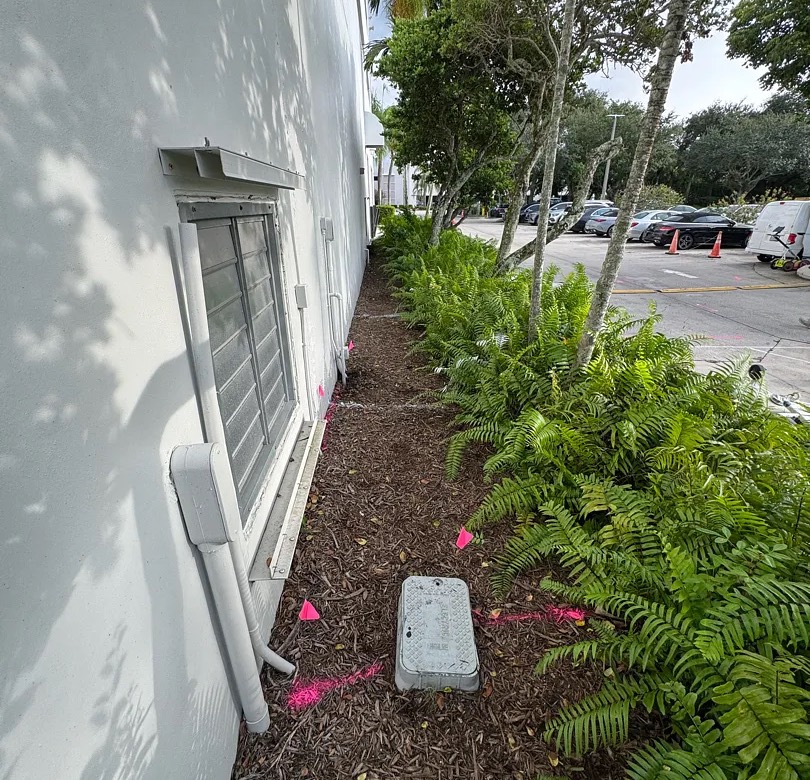
The meter is your anchor point, so find it first. In South Florida it is almost always a rectangular concrete or plastic box set flush with the ground near the front property line, in the grass strip between the sidewalk and the street, beside the edge of the driveway, or just inside the line. The lid usually reads WATER or carries a utility name, and it lifts with a flathead screwdriver. Inside you will find the meter and normally a shut-off valve, which is worth knowing the location of whether or not you ever dig. The service line leaves the box on the house side and heads toward the building. That direction is your starting assumption, and it is only an assumption.
Read the Clues in Your Yard, Then Doubt the Straight Line
Walk the ground between the meter and the house and look properly. Small round lids or valve covers sitting in the turf. An irrigation valve box. A cleanout pipe standing up out of the grass, which is sewer rather than water but tells you something is routed through there. A stripe of grass that is greener or grows faster than everything around it. A patch that stays soft or damp after a dry week. A faint long depression where a trench settled years ago. A patched seam across a driveway or walkway where somebody cut, laid pipe, and repoured. Then look at the house itself: the main shut-off on an exterior wall, the first hose bib, or the water heater usually point back toward where the line comes in.
Here is the part worth taking seriously. On a recent residential job we traced a water service running from the meter to the property, and it did not run where the homeowner believed it ran. That is not unusual, it is normal. Service lines get routed around whatever happened to be in the way the day they went in: a driveway already poured, a mature tree, a planting bed, an older drainfield, a pool that came later. Additions and re-plumbs move things. A line put in decades ago may have been rerouted twice since. The homeowner had a mental map of a straight line between two points. The pipe had taken a different path, and a shovel following that mental map would have found it the hard way.
Why Guessing Fails in Florida Specifically
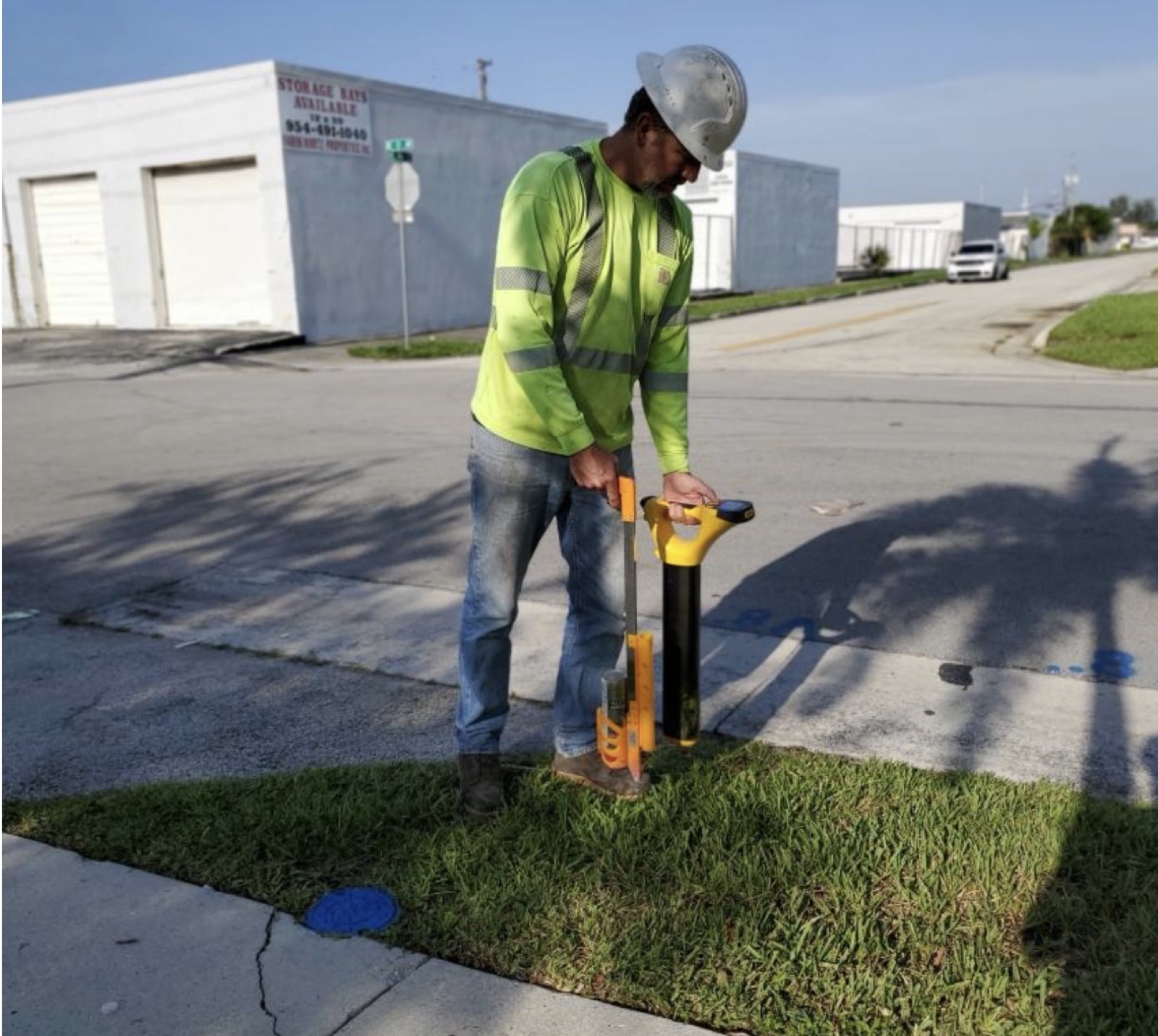
Even homeowners who go buy a tool come up empty here, for a material reason. A great deal of residential water service in Florida is non-metallic: PVC or polyethylene. Plastic pipe carries no magnetic signature and conducts no current, which means a consumer metal detector cannot find it, a stud finder cannot find it, and a phone app advertising metal or magnetic detection certainly cannot. Those apps read the handset's magnetometer and cannot see anything meaningful through soil. If your service happens to be older galvanized or copper you might get a reading close to the surface and nothing deeper. The trap is that you cannot know which material you have without seeing the pipe, so a quiet detector tells you nothing at all.
And the downside is all yours. Put a post hole digger through a live water service and it happens fast: water under pressure, a hole filling quicker than you can bail it, and a scramble to find a shut-off you may never have located. Then an emergency plumber, at whatever hour and whatever day it happened on. Because the line past the meter is private, that repair is at your expense. The utility is not coming out to fix it, and having pulled a permit for your project does not change that. Add the yard reopened, the landscaping put back, and the project stopped while it gets sorted out.
When to Stop Guessing and Have It Located
Call when the stakes stop being small: anything deeper than a shovel's worth of topsoil, anything involving an auger or a machine, fence posts, pool excavation, driveway removal, footings, a large tree going in, or a leak you need exposed without opening up the whole lawn. Residential locating with US Utility Potholing starts at $400 for a simple job, meaning a single short run or clearing a small defined area of roughly 15 feet. That is a starting point rather than a whole-property price, so a larger or more congested lot costs more, and we will tell you which one yours looks like before we come out. Ground penetrating radar runs on every job alongside electromagnetic locating, so non-metallic pipe is not a blind spot for us. One honest limit worth stating plainly: locating gives horizontal position, meaning where the line runs. It does not give depth. Depth takes a test hole. We are licensed and insured, and you can reach us at (954) 849-2859.
Frequently Asked Questions
Does 811 find the water line between my meter and my house?
No, and this is the most common misunderstanding. The 811 ticket covers publicly owned utilities up to the meter. The service line running from the meter to your house is private, and so are irrigation, septic, and any electric run to a shed or pool. Nobody from the utility marks those. That private stretch is exactly where most homeowner digging accidents happen, so it needs a private locate.
How deep is a residential water line in Florida?
There is no universal number, and anyone who gives you one without digging is guessing. Depth varies with the age of the installation, the contractor who put it in, the grade of the lot, and any regrading or resurfacing done since. Locating equipment gives you horizontal position, meaning where the line runs, not how far down it sits. The only way to confirm depth is a test hole that exposes the pipe.
Can I find my water line with a metal detector or a phone app?
Usually not. Much of the residential water service in Florida is PVC or poly, which is non-metallic and gives a metal detector nothing to react to. Phone apps claiming to detect pipes read the handset's magnetometer and cannot see through soil at all. Even with older copper or galvanized pipe, a quiet detector is not proof of an empty trench. Professional locating uses electromagnetic equipment and ground penetrating radar together.
What happens if I hit my water line while digging?
You will get pressurized water immediately and a hole that fills faster than you can empty it, followed by finding a shut-off quickly, usually at the meter. After that you are calling an emergency plumber at whatever hour it happened. Because the line past the meter belongs to you, the repair is at your own cost, and so is putting the yard and landscaping back afterward. Your project stops until it is fixed.
What does it cost to locate utilities on a residential property?
Residential locating starts at $400 for a simple job, such as a single short run or clearing a small defined area of roughly 15 feet. That is a starting price, not a whole-property rate, so a larger or more congested lot costs more. Tell us what you are digging and where, and we will tell you what your property actually needs before scheduling. Call (954) 849-2859.
Have It Found Before You Dig
Call 811 first — always. Then, if you need the private side of your property found too, residential utility locating starts at $400 for a simple job. Call (954) 849-2859 or request a quote.
Related: residential utility locating · what locating costs · test holes for depth · more guides